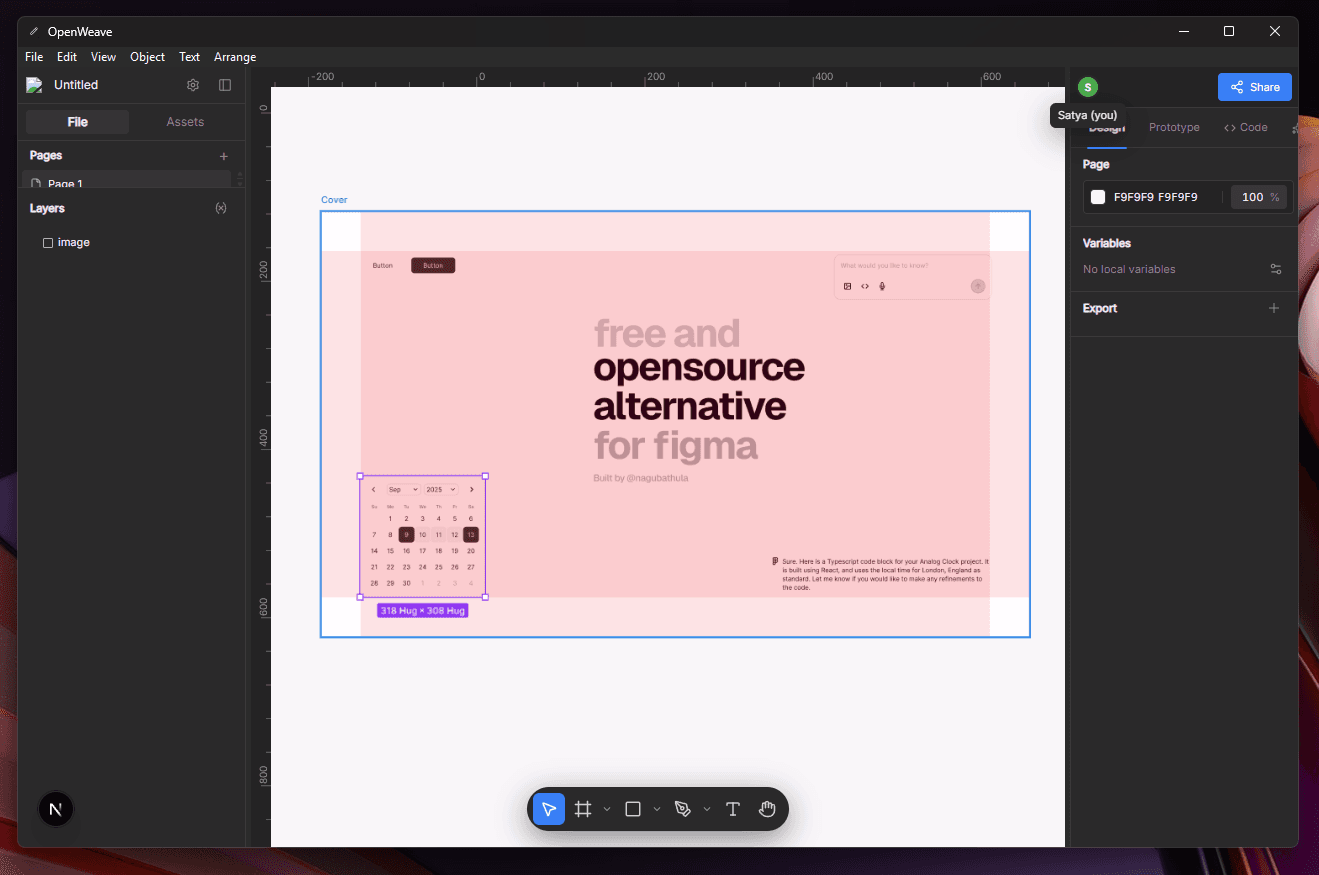
Why I built it
Design tools are closed ecosystems: your files live in someone else's cloud, and automating anything means fighting a plugin sandbox. OpenWeave is my answer — a design editor that treats the design file as an open, inspectable document you own, and the editor itself as a programmable toolkit rather than a walled garden.
What it does
- Opens native design files — reads and writes Figma
.figand Pencil.pendocuments, with copy & paste between apps. - AI builds designs — describe what you want in chat and 90+ tools create and modify nodes. Works with Anthropic, OpenAI, Google AI, OpenRouter, and compatible endpoints.
- Fully programmable — headless CLI, XPath queries over the node tree, Figma Plugin API support, and an MCP server so AI agents like Claude Code can drive the editor.
- Design-to-code — export selections as JSX/Tailwind, extract design tokens, lint naming, layout, and accessibility.
- Real-time collaboration — peer-to-peer over WebRTC with cursors, presence, and follow mode. No server, no account.
- React SDK — headless components and composables for embedding the editor into other apps or building custom editing surfaces.
Under the hood
A monorepo of focused packages — scene graph, file-format codecs, core engine, React bindings, CLI, and MCP server — built with Next.js and TypeScript. Auto layout and CSS Grid run on Yoga WASM, and the desktop app ships as a ~7 MB Tauri v2 binary for macOS, Windows, and Linux, with the same code running in the browser as a PWA.